
Our Children Are Being Given a Story. Make Sure It Is Not Someone Else’s.
Written from Istanbul, March 2026
Written from Istanbul, March 2026
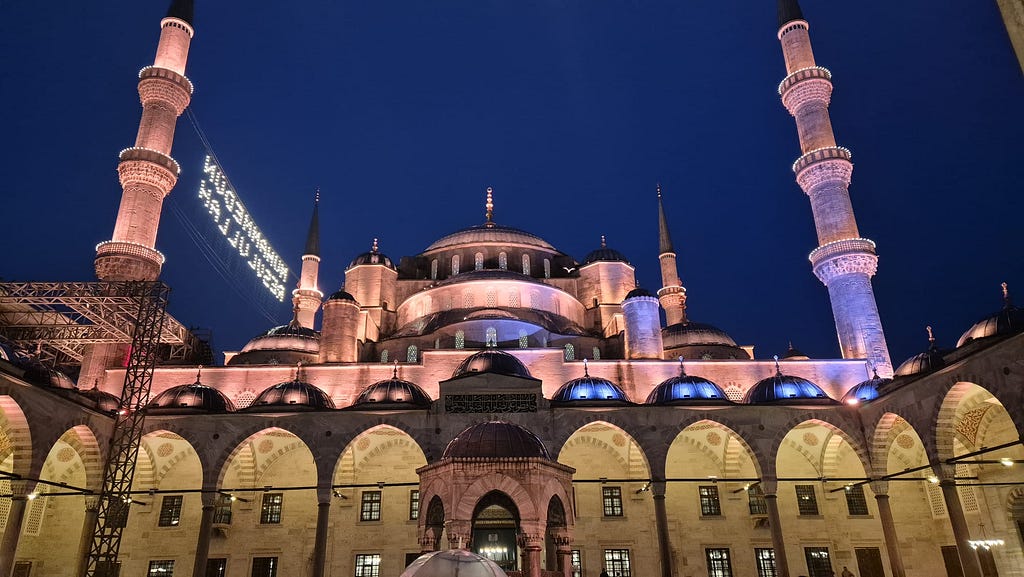
This trip feels strange. We were not meant to be alone in Istanbul. We were meant to be in Palestine, sitting in the shade of Masjid al-Aqsa, having conversations deep into the night with the friends we made. But our flights got cancelled, so we re-routed to Turkey. Akeel and Hannaa and little Sara were meant to join us on this trip. And for Umrah after. But Allah took them into His custody last June, and it still feels surreal. How they would have loved Istanbul, especially Hannaa, who had a keen eye for history, and did what she could to pass it on to little Sara. I imagine Akeel would have lovingly scoffed at her meticulous planning and her prior research, and would have been the fourth of three children in our little group. Nevertheless, we plough on, and we learn lessons from the life they lived and the love and joy they shared.
I have been to Istanbul before. I came years ago with my wife, before our son was born. In fact, I have authored two travelogues about our visit. At that time the Hagia Sophia was a museum. You walked through it as a historical site, remarkable, but detached from living practice.
This week I stood in the same building with my son, and it was a beautiful masjid. Maybe a bit bare, but beautiful nonetheless. The adhan had just finished. He looked around and said: why does it look different to other masjid?
I explained that the last time I had been here, it was a museum. That before that, for centuries, it was a masjid. That before that, for nearly a thousand years, it was the greatest cathedral in Christendom. He looked at me and said: how did it become a masjid? And I found myself reaching. I didn’t really know what to say.
I knew enough to tell him about the conquest of Constantinople, now known as Istanbul. And then the inevitable, ‘Eh, why is it called something different now?’ But I was patchy on the detail, the timeline, the significance, what it meant for the Muslim world at that moment. I gave him fragments when he deserved the full account.
That evening, back at the hotel, we found a documentary about the Ottomans and sat together and watched it. Within an hour, my son had learnt what I had failed to give him while standing inside that building. The following day, when his cousin joined us at the Blue Mosque, he was holding court. Telling him about Sultan Mehmed al-Fatih, the Conqueror, how he had commissioned an innovative cannon to breach the walls of Constantinople, how he had studied the city’s defences for years before attempting it, how he entered the Hagia Sophia and converted it to a mosque on the day of the conquest. The detail, the enthusiasm, the confidence in his voice. All it took was one documentary on one evening.
It made me think about what else we are not passing on, and why.
We Do Not Know Our Own Story
I do not think I am unusual in what happened in that building. If anything, that is the point.
Ask the average Muslim adult in Britain, educated, practicing, community-minded, about Bayt al-Hikmah, the House of Wisdom in Baghdad, and they will give you a vague nod. Ask about Al-Andalus (Muslim Spain and Portugal), and they might recall the name Córdoba. Ask about how the Ottoman state was actually administered, or what the Mughal emperors built, and most of us will trail off.
This is not a criticism. It is an observation about what we have and have not been given. Most of us were not taught this history, not at school, not at madrasa, not at home, because the people who raised us were not taught it either. The gap has been passed down alongside everything else.
Part of the reason is simply the way history is framed in the education most of us received. We were all taught about the Dark Ages, that period in European history after the fall of Rome when knowledge stagnated and progress halted. It is a familiar story. What that framing omits is that while Europe was in its so-called Dark Ages, the Muslim world was in the middle of its Golden Age. Baghdad was the intellectual capital of the world. Muslim scholars were preserving Greek texts that Europe had lost, translating them, building on them, and producing new fields of knowledge. The period taught to our children as a global pause was, for our civilisation, a period of flourishing.
The term Dark Ages is a product of Eurocentric thinking, the habit of narrating world history as though Europe is the main character and everyone else appears only when they become relevant to that story. Our children absorb this framing without realising it, and it shapes how they understand their own place in history before they are old enough to question it.
What we talk about when we talk about preserving Muslim culture tends to land in the same three places: food, clothes, and language. For many of us: Biryani, Shalwar Kameez and your choice of Urdu, Gujarati, Bengali and Punjabi. These things matter and they are worth holding onto. But they are the surface of a culture. A culture is also the story a people carries about itself across time. The accumulated memory of what was built, what was lost, what people believed and what it cost them to keep believing it under pressure. Food and clothes and language without that deeper story is, eventually, just aesthetic. You have the garments but not the body inside them.
People who know their history tend to carry themselves differently. Not with arrogance, but with a degree of contentment, even pride. They can be challenged and they do not immediately buckle, because they have ground beneath them. They can sit with criticism without being destabilised. Knowing your story builds a confidence that is hard to manufacture any other way, and it is available to all of us if we do the reading.
What Happens When You Take Away A People’s Story
History is fairly clear about how you break a people, and it rarely begins with force. That usually comes after. It begins with education. Colonial powers replaced native languages with the coloniser’s tongue, redesigned curricula so that children grew up learning the history and heroes of the empire rather than their own, and taught the colonised to see their civilisation as something to be left behind. The aim was not just political control. It was the removal of the story a people told about itself, because a people without that story is far easier to direct.
This happened to Muslim communities across the subcontinent, North Africa, and so many other regions. The generation that came to Britain in the 1950s onwards, often arrived already carrying this, an education that had taught them their own inheritance was inferior. The healing from that has been incomplete, and the effects are still visible. I call it post-colonial trauma. One more trauma to add to the endless list.
A person who does not know their history cannot pass it on. They will tend to accept the story they are given, including, sometimes, the story that they are a problem or an outsider with no claim to significance. That is not a warning about what might happen. It is a description of what already has.
Identity Is a Battlefield, and Others Know It
It is worth being honest about something that often goes unsaid.
The far right understand the power of historical identity very well. Policies only become a focus once they have told their stories. They invoke a version of history, selective and often distorted, that gives their followers a sense of belonging, a sense of coming from something significant, a sense of a great inheritance under threat. They offer heroes, enemies, a narrative of loss, and a call to reclaim. It works, because the human need for a story to stand on is real and they are meeting it. Even if it is inaccurate.
They know that if you can tell someone where they come from, you can shape who they believe they are. And if you can shape who someone believes they are, you can point them almost anywhere.
We look at this and are rightly troubled by it. The answer cannot be to treat historical identity itself as the problem. The answer is to take it seriously with a degree of intellectual honesty, to build a real relationship with our own history and pass it on, with intention, very deliberately. They are doing it with a distorted story. We have a true one, and we are barely telling it.
What We Actually Come From
Let’s refer back to Bayt al-Hikmah, the House of Wisdom in Baghdad, where scholars from Persia, Arabia, India, and Central Asia gathered to translate, debate, and produce knowledge that changed the course of human history. The mathematical system we all use came through Islamic scholarship. The word algebra comes from the title of a book by Al-Khwarizmi. The word algorithm comes from his name. Ibn Sina’s Al-Qanun fi’l-Tibb, the Canon of Medicine, was the standard medical textbook in European universities for six centuries after his death. Al-Zahrawi’s Al-Tasrif described surgical instruments that remained in use for a thousand years. May Allah have mercy on all those who served the community.
It is a travesty that history has confined these unique achievements to footnotes. They are foundations the modern world was built on, during the very period European history chooses to call dark.
Al-Andalus at its height was among the most sophisticated societies on earth. Córdoba had street lighting and running water while London was a market town. Muslims, Christians, and Jews produced scholarship together that fed into what we now call the Western intellectual tradition. And then, over generations, it was dismantled through military campaign, forced conversion, and expulsion. The Muslims who remained, prayed in secret, hid the Qur’an under floorboards, and wrote Islamic texts in Spanish using Arabic script so their persecutors could not read them. Hundreds of thousands were eventually expelled, many killed before they reached the coast. Most held their faith through all of it.
We know so little about Salahuddin al-Ayyubi, Kurdish by birth, Sultan of Egypt and Syria, who united a fractured Muslim world and recaptured Al-Quds in 1187. When he took the city, he did not massacre its inhabitants. His enemies were among those who documented his mercy. There is something worth noting about a figure whose character was recorded admiringly even by the people who fought against him.
And before all of this, before the empires and the scholars and the conquests, there were the Sahaba radhi-Allahu anuhm, the companions of the Prophet ﷺ. Can our children even recount the names of the ten promised Jannah? Or even the four rightly guided khalifs? Abu Bakr al-Siddiq. Umar ibn al-Khattab. Uthman bin Affan. Ali bin Abi Talib. Can they name the children of our beloved? Have they heard of the achievements of people like Khalid ibn al-Walid? The resilience and iman of people like Bilal ibn Rabah? Proper heroes. May Allah be pleased with them all. Giants who stood at the moment the world changed and gave everything they had. We name our children after them, and that is not a small thing. A child named Umar or Khalid or Fatimah carries a story in their name before they can read. They just need someone to sit down and explain whose name they bear and what that person did with their life.
That conversation, and everything it opens up, deserves its own piece. Now is not the time for it.
Al-Aqsa Belongs In This Conversation
When we talk about history and Muslim identity, we cannot forget Masjid al-Aqsa.
Masjid Al-Aqsa, and the language matters here so it is worth being precise, is not simply a political issue to be raised in times of crisis. It is the Noble Sanctuary, only one of three Masjids the Prophet gave us encouragement to visit, the ground upon which prophets prayed, where the Prophet ﷺ led all the prophets in salah on the night of Al-Isra wal-Mi’raj. Its sanctity is not a modern political claim. It is woven into the foundations of the faith.
Most Muslim children, and most Muslim adults, would struggle to describe it accurately. To explain what it is, what it contains, which prophets walked that ground, what it means that it was our first Qibla. We speak about it in times of conflict and fall silent otherwise, which means our children absorb it as a geopolitical issue rather than as one of the most sacred places in our tradition. Out of sight, out of mind. And if that hurts, next time you book a holiday, rather than a fancy Turkish resort, or a trip across the world to Bali, consider visiting Al-Aqsa and the heroes who defend it from the occupation forces.
To know our history fully is to know Al-Aqsa fully. That knowledge changes how a person relates to it, from something happening to other people somewhere far away, to something that is, in the most literal religious sense, theirs.
The Ummah Is Not Abstract
When we say Ummah we are pointing at something that has no real equivalent in history. Not an ethnicity, not a nation, not a language community. A community spanning fourteen centuries and every continent, held together by faith and shared history. A community in which a Kurdish general united Arab, Turkish, Persian, and Egyptian forces around a common purpose. In which scholars from dozens of different backgrounds collaborated in Baghdad under a shared project. In which, when Muslims were expelled from Spain, the Ottoman Sultan sent ships to bring them to safety.
When a child understands that history, the Ummah stops being a word they hear in a du’a and becomes something they can actually feel. They understand that the scholars of Baghdad were their scholars. That Salahuddin was their leader. That the Moriscos who prayed in secret were their people across time. That belonging to the Ummah means something concrete and something old, stretching far beyond whatever is happening to them in a classroom in Gloucester or Bradford or Tower Hamlets.
That sense of belonging is what history gives a child that nothing else quite can.
What Allah Already Told Us
It is worth noting that none of this is a new idea.
A third of the Qur’an is historical narrative. Allah tells us plainly why:
“So relate the stories, that perhaps they may reflect.” (Al-A’raf: 176)
“Indeed in their stories there is a lesson for people of understanding.” (Yusuf: 111)
The story of Prophet Yusuf alayhis salam is called ahsan al-qasas, the best of all stories: betrayal, exile, temptation, imprisonment, and ultimately forgiveness and elevation. The Prophet ﷺ narrated the stories of previous nations to his companions as formation, a guide, an inspiration, not entertainment. He was giving them a framework for understanding their own lives by showing them who had come before.
The Islamic tradition has always understood that story is how identity is built and passed on. We have, somewhere along the way, let that understanding lapse. Recognising it is straightforward enough. Acting on it just requires a decision to start.
This Is For All Of Us
This is not only a message for parents, or teachers, or people who work with young people.
The gap in historical knowledge is not only something we worry about in the next generation. Most of us carry it too. Like one of my teachers says, ‘you worry about the nasl (the children), but you forget about the asl (the parents). Fix the asl, and the nasl will follow’. How true ring those words. Consider those moments of hesitation when someone challenges something about Islam and you reach for a response but cannot find it. The frustration when someone implies Muslims contributed nothing to the world, and you know it is wrong but cannot say with confidence exactly why. The feeling that your identity is always on trial and you are defending it from uncertain ground.
Knowing your history addresses that, not by giving you arguments to win, but by giving you a settled sense of what you are part of. There is a difference between a person who says they are Muslim because it is what they were born into, and a person who says it knowing the full weight of what they are claiming. One is an inherited label. The other is an identity, and it is built over time through exactly this kind of knowledge.
It starts small. A documentary watched as a family. Ta’leem from a book about the great companions. A name explained to a child who had never been told whose name they carry. A question answered properly rather than deflected. Every little helps, and we don’t know which conversation lights the flame of iman in our homes.
One Last Thought
We’re heading to Umrah today, inshaAllah. Then in 10 days, back to Gloucester, feeling a little bit inspired. Maybe there is a curriculum in our school we need to rebuild. I feel that is the practical response to a practical failure, and it is overdue.
The larger thing I am taking home is harder to reduce to a list. It is something closer to a renewed sense of responsibility, to my son, to the children in my school, to the community I serve, and honestly to myself. I’ve started with this blog post, and I have already compiled notes on Ottoman history for those who wish to visit Istanbul. You have to start somewhere, and Istanbul is the beginning of my little project, my story.
And yes, we do have a story. It is long and honest and sometimes difficult and often extraordinary. The Ummah was made of real people with real stories. We just don’t know them and their stories. The Sahaba were real human beings who changed the world with a level of conviction most of us will never be called to match.
These stories do not need to be romanticised. They are good enough as they are. They just need to be told.
Know your story. Sit with it. Pass it on.