
Remembering Maulana Shabbir — the cornerstone of the Gloucester Muslim community
Scattered thoughts and lessons from the life and death of Maulana Shabbir rahmat-Allahi alayh.
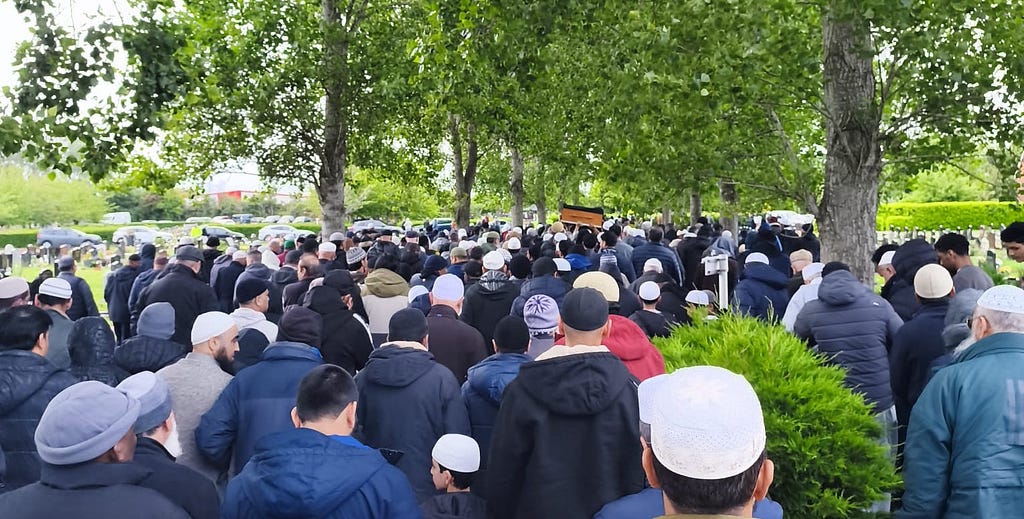
Maulana Shabbir, our local Imam in Gloucester, has passed away. Inna lillahi wa inna ilayhi raji’oon. His Fajr was prayed in the first saff, and his Zuhr with the angels. For more than thirty years, he served this community as Imam, Khateeb, teacher, conductor of Nikah ceremonies, and the first to be available for the ghusl of the dead and to lead the janaza. He must have done hundreds of each in his time.
The news reached me at 1:30 pm on the Monday. He had collapsed in town and the medics were unable to resuscitate him. His time was written. He did not live to see his 70th birthday. I was out of town for work when the message came, and I just sat with the shock. Disbelief. Which Maulana Shabbir? Our Maulana Shabbir?
My first thought was for my father. They were best friends. Their relationship began before either of them moved to the UK, two men of similar ages who became like brothers. When I arrived at the house on returning to Gloucester, I spotted my father there, looking pale. I rolled down the car window and asked how he was. he replied in perfect English, “Beta, I lost my brother and my best friend.” My heart sank. I remember, when my mother passed away, beyond our immediate family it was Maulana Shabbir and his family who served us. We made sure to visit each other on every Eid. At recent weddings he would take my son on his lap and feed him morsel by morsel like a doting father. To my detriment, I had drifted from older relationships which my parents took so long to create and maintain, weighed down by work and community commitments. It is hard to find time for everyone, but that sentiment feels heavier now that people like Maulana pass away.
When I became a hafiz, he gifted me exactly £351. Why that figure? So my father could take me to Umrah. That was his gift. Not a Playstation. Something I now understand was intended to strengthen my connection to Allah’s Deen. He was the first Imam of Masjid e Noor to give me the musalla, to put me forward to lead Jum’a and the taraweeh prayers. His unassuming character meant he did not often offer public praise, but I will not forget the words he said to me after the first salah I led there.
His death has hit everyone. Young and old, whatever language you speak, whichever country you originated from. An Imam like Maulana Shabbir had a way of serving everyone, not only his close circle or those who could benefit him. A friend messaged me: “After dad, he was literally the biggest male influence I had when growing up. What a legend of a man.” And there will undoubtedly be many more stories like these.
He had two close friends, and members of both families were by his side when he eventually passed. His three sons and the families of those two friends were present for the ghusl. As we performed it, we noticed a clear smile on his face. Such a smile is rare. He passed on a Monday, the day of the Prophet ﷺ’s demise, coinciding with 1st Dhul Hijjah, the best days of the year. We washed his hands and arms several times, as is the practice, and by the time his fingers came to rest, across both hands his three fingers had curled and his tashahhud finger remained straight, or only slightly curled, as if he was sitting in salah. It was an incredible thing to witness. We take solace from these as good signs at the time of death.
The Arabs have a saying, mawt al-alimi mawt al-aalam, ‘the death of a scholar is the death of a world’. It is a cliche of sorts about the value of an Alim of Deen. But on this day it felt genuine. A dark cloud had taken its place over Gloucester. The skies darkened and the rain drizzled. It is not often that a janaza takes place at 8pm in the UK on the same day as the passing. But this was Maulana Shabbir. Whenever he was responsible for the ghusl and janaza arrangements, he would insist on getting it all done as soon as possible, acting on the command of our Nabi ﷺ. Surely it was this commitment to the Sunnah that saw these closed doors open for him. This is the reward for the one who spends his life serving the Deen of Allah and the community.
Our Nabi ﷺ said:
“Allah does not take away knowledge by snatching it from the people. He takes it away by taking the scholars, until none are left, and people take ignorant men as leaders, who give rulings without knowledge, going astray and leading others astray” (Sahih al-Bukhari, 100).
The illuminated souls who once filled this Masjid are being taken from us one by one. Each loss leaves the building dimmer than before.
There are many lessons to take from his life. His punctuality with salah in the Masjid. His care for the elderly, visiting them regularly, to the extent that he would set their chairs in place before Fajr. His daily litanies of tilawat, dhikr and dua, kept without interruption. And for me especially, his no-fuss attitude to performing all those hundreds of nikahs and ghusls that became his forte. His Monday tafsir lessons were well attended in person but under-appreciated by many who now live with the regret of having taken them for granted.
It is this consistency we will miss. The punctuality that made his name synonymous with the Muslim community of Gloucester. His entire life was spent as an Imam, beginning in India, moving to South Africa, and arriving in England during the 90s. What an act of dedication to the Ummah. He had no degree, no title besides his name, no medals or marks of honour. And yet the numbers at his janaza comfortably exceeded a thousand, the largest janaza Gloucester has ever seen.
Consider it. Dozens of doctors and solicitors have passed away in our communities, men with multiple houses, booming businesses, sizeable pay packets and larger bank accounts. None of them have drawn a gathering like this. The simple Molwi who came from an Indian village, who served Allah’s Deen and his community with selflessness and commitment, drew a thousand mourners. We have witnessed businessmen whose own children did not attend their janaza. The Molwi is a particular kind of specimen, mocked and under-appreciated in his lifetime, and yet the very same people who did not value him in this world made the effort to be at his janaza.
We look everywhere for success. Universities, degrees, high-paying jobs, senior roles. The man with none of these pulled at our hearts in a way only a carrier of Allah’s Deen could.
There is an Arabic description that fits him precisely: majhul fil-ardh, ma’ruf fis-samaa: “Unknown on earth, famous in the heavens.” It draws on a hadith of our Nabi ﷺ:
“When Allah loves a servant, He calls Jibril and says, ‘I love so-and-so, so love him.’ Jibril loves him. Then Jibril calls out to the inhabitants of the heavens, ‘Allah loves so-and-so, so love him.’ The inhabitants of the heavens love him. Then acceptance is placed for him on the earth” (Sahih al-Bukhari, 3209).
Allah promises this of His sincere servants in the Quran:
“Indeed, those who believe and do righteous deeds, the Most Merciful will appoint for them affection” (Surah Maryam, 19:96).
The acceptance Allah places for His beloved on the earth has been visible in Gloucester. The gathering at his janaza was one sign. The volume of taziyat received from other respected Ulama since, by phone call and by messages, has been another.
And yet look at how we treat our Ulama in their lifetime. We tend to look down on them, sometimes find ourselves guilty of mistreating them, and rarely do we make their lives easy. We take their availability for granted, as if their being available for every janaza, every nikah, every late-night emergency call were an entitlement rather than a service. We do not want our own children to become Ulama. Our Darul Ulooms struggle to make ends meet due to dwindling numbers. We push them towards medicine, law, engineering, finance, anything but the Deen.
And when we lose one of those Ulama, we witness what success truly was. The people do not lie. A thousand turn out in the rain at 8pm for the kind of man we do not want our sons to become.
Success is not in the paycheck or in the honour of this world. Success is determined at and after your death. Everything else is a show, a glittery ball held up to take our attention away from the Hereafter. As witnesses for Allah in His creation, we bear witness that Maulana fulfilled his duty. I am not writing this looking at anyone else. There is a lesson in here for me, and for others like me.
May Allah elevate his ranks, accept his service for the Deen and for his community, bless him with the company of the pious and the prophets, and grant a beautiful patience to his family and friends. Ameen.