
Boycotting Umrah: A Step Too Far?
Across the Ummah, in the gatherings of laypeople and ulama alike, I have noticed a question gaining ground: should we still be going for Umrah?
Across the Ummah, in the gatherings of laypeople and ulama alike, I have noticed a question gaining ground: should we still be going for Umrah?
The people raising it love the sacred cities and hold their faith seriously, which is precisely why the question troubles them. They are often the most engaged in their communities, those who follow the news, who feel the weight of what is happening in Gaza, Syria, Sudan and Yemen, who have watched scholars they respect be imprisoned without charge, and who are genuinely asking whether making that journey, spending that money, entering that country, amounts to a form of complicity they cannot reconcile with their conscience.
The question keeps returning because most people raising it are not looking for permission to stay away. They want a reason, in good conscience, to go. It sits between two principles that Islamic scholarship has always held together: the obligation to resist oppression and avoid contributing to it where possible, and the principle that acts of worship are done for ourselves, and are not dependent on the righteousness of those in power. Any serious discussion has to appreciate both perspectives, which is the aim of this piece
Why This Question, and Why Now?
The concern, at its core, is not simply about normalisation deals or diplomatic handshakes. It is about a pattern: Gulf states perceived to be actively weakening the Ummah from within; silencing its scholars; undermining its movements; and aligning with its enemies - while Muslim blood continues to be shed across the Muslim world - with little more than silence from those who claim custodianship of the two holiest sites on earth. The Abraham Accords are one symptom of that pattern, not the diagnosis itself.
Scholars beloved across the Ummah sit in Saudi prisons, their apparent offence being insufficient loyalty to the regime’s political direction. Gaza continues to endure what it endures. Migrant workers complain of oppressive working conditions. Masjid al-Aqsa remained closed for 40 days, an unprecedented state for over 500 years. Innocent Iranian schoolgirls are being indiscriminately killed. Sudan and Yemen have suffered in ways that implicate Gulf decision-making directly. For many sincere Muslims, this context defines the entire question. The response, ‘I cannot, in good conscience, be a part of this’, is born of love for the believers and love for justice.
The Quran instructs us:
وَتَعَاوَنُوا عَلَى الْبِرِّ وَالتَّقْوَىٰ وَلَا تَعَاوَنُوا عَلَى الْإِثْمِ وَالْعُدْوَانِ
“Cooperate with one another in goodness and righteousness, and do not cooperate in sin and transgression.” (Quran 5:2)
The Prophet ﷺ reinforced it: “Whoever among you sees an evil, let him change it with his hand. If he is unable, then with his tongue. If he is unable, then with his heart, and that is the weakest of faith.” (Sahih Muslim)
For many, the concern goes beyond politics. The rapid expansion of public entertainment near sacred sites, the silencing of scholars, and the normalisation of practices long considered impermissible have led some to invoke the Quranic warning:
وَلَا تَرْكَنُوا إِلَى الَّذِينَ ظَلَمُوا فَتَمَسَّكُمُ النَّارُ
“And do not incline toward those who do wrong, lest you be touched by the Fire.” (Quran 11:113)
Rather than rejecting worship, those who hesitate about Umrah are merely asking whether their presence indirectly supports a system they believe is acting unjustly. If you have already stopped flying Emirates, and would not holiday in Dubai, it is entirely natural to ask why Saudi Arabia receives a different calculation.
The Moon, the Eids, and Hajj Itself
The same authority that issues visas for Umrah also determines the timing of Arafah, which shapes when large swathes of the Muslim world celebrate Eid al-Adha. Saudi scholars themselves have often instructed Muslims in other countries to follow their own local moon sightings, yet in practice the rhythm of the Islamic year remains, for most Muslims, connected to Saudi administration of the sacred rites.
Hajj makes the principle even clearer. No recognised body of scholarship, not in times of Umayyad tyranny, not under the Abbasids, not now, has ever ruled that the obligation is suspended because of the character of those administering the sacred precincts. The condition for Hajj is ability, not approval of the regime. Scholars across the juristic tradition have consistently affirmed the validity of pilgrimage despite the injustice of rulers. If that principle holds for Hajj, a pillar of the faith, a serious argument needs to explain what makes Umrah categorically different.
History’s Great Reminder
Allah said of the House:
وَإِذْ جَعَلْنَا الْبَيْتَ مَثَابَةً لِّلنَّاسِ وَأَمْنًا
“And when We made the House a place of return for mankind and a place of safety.” (Quran 2:125)
A place of return. The Haram has remained active regardless of who held power around it, across fourteen centuries and without exception.
Hajjaj bin Yusuf al-Thaqafi (the infamous tyrannical Umayyad Governor) besieged Makkah with catapults, damaged the Ka’bah, and killed companions like Sayyiduna Abdullah bin Zubayr (radhi-Allahu anhu), grandson of Sayyiduna Abu Bakr al-Siddiq (radhi-Allahu anhu), hanging his body at the gate of the Masjid al-Haram. The Tabi’in continued to perform Hajj and Umrah throughout his reign, separating the corruption of the man from the sanctity of the place.
In 317 AH, the Qaramita, a historical Shi’a sect, attacked pilgrims mid-tawaf, massacred worshippers, threw bodies into the well of Zamzam, and wrenched the Black Stone from its place, carrying it to al-Ahsa where it remained for over twenty years. The Ummah still came, still circled, still prayed.
Perhaps the most instructive example comes from the Prophet ﷺ himself. At the time of the Treaty of Hudaybiyyah, both Makkah and the Sacred Mosque were under the control of the Quraysh, who were not merely corrupt Muslims, but active disbelievers at war with the Prophet ﷺ and his companions. Once the treaty was concluded, the Prophet ﷺ led his companions to perform Umrat al-Qadha the following year, still under Qurayshi administration. The money spent in Makkah during that Umrah reached Qurayshi hands and may well have contributed to the resources later used against the Muslims. If the Prophet ﷺ performed Umrah under those conditions, the argument that Saudi governance today renders it impermissible, requires an exceptionally high burden of proof.
No regime has ever owned the Haram. At most, it has managed access to it for a time.
Are We Really Complicit?
Mufti Shafi Usmani (rahmat-Allahi alayhi) addresses the underlying principle in his book, Jawahir al-Fiqh. The determining factor in questions of complicity is one’s direct action, not the downstream use of money by others. If a person buys groceries from a shop that also sells alcohol, that purchase does not make them a participant in the sale of alcohol. Indirect benefit separated by multiple steps and intentions does not carry the same moral weight as direct participation. A person performing Umrah is performing tawaf, not funding Saudi foreign policy.
There is also a consistency argument worth stating plainly. Cars, computers, and mobile phones generate significant revenue for American corporations whose foreign policy has caused enormous harm to Muslim communities worldwide, with far more direct consequences than a pilgrim’s hotel bill in Makkah. If we are not prepared to boycott phones and laptops on that basis, the intellectual honesty demanded by the Umrah boycott argument becomes harder to sustain.
Umrah Is for You — Not for Them
The Prophet ﷺ said: “The pilgrim performing Hajj and the one performing Umrah are guests of Allah. If they ask of Him, He will answer them.” (Sunan Ibn Majah)
A single prayer in Masjid al-Haram is equivalent to one hundred thousand prayers elsewhere (Sunan Ibn Majah), and a single prayer in Masjid al-Nabawi is equivalent to one thousand (Sahih al-Bukhari). Umar ibn al-Khattab (radhi-Allahu anhu) made a du’a considered almost impossible: “O Allah, grant me martyrdom in Your cause, and let my death be in the city of Your Prophet.” It came to pass exactly as he had asked.
We also believe in the ultimate authority of Allah, the Mighty and Wise:
قُلِ اللَّهُمَّ مَالِكَ الْمُلْكِ تُؤْتِي الْمُلْكَ مَن تَشَاءُ وَتَنزِعُ الْمُلْكَ مِمَّن تَشَاءُ
“Say: O Allah, Owner of Sovereignty, You give sovereignty to whom You will and You take sovereignty away from whom You will.” (Quran 3:26)
The Saudi regime’s authority is not permanent, and no regime’s authority has ever been permanent. The House of Allah has outlasted every administration that thought it owned the surrounding land.
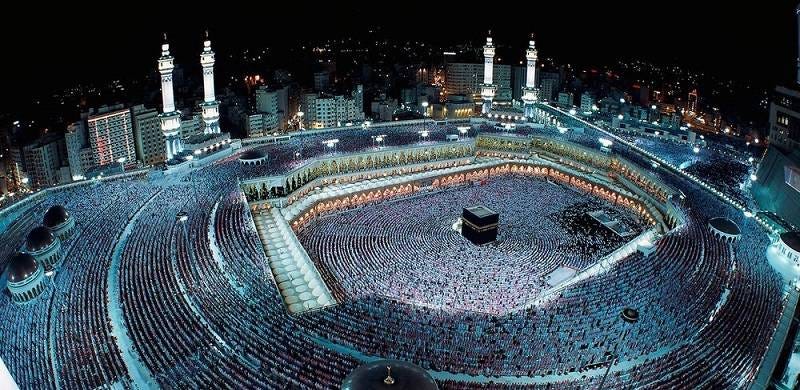
And there is something else worth mentioning. Outside of Hajj, there is no gathering in Muslim life that draws the Ummah together the way Umrah does. The traveller from Bradford sits beside the one from Beirut, from Karachi, from Jakarta, from Cape Town, with no national divisions in the tawaf and no sectarian seating arrangements on the musalla. When the most conscientious Muslims choose to stay away, they are not only giving up their own du’as and their own forgiveness; they are giving up their place in that gathering.
By staying away from Allah’s house, you deprive only yourself. Withdrawal does not neutralise the space. It just changes who fills it.
For the Record
None of this is a defence of Saudi Arabia. The imprisonment of scholars is wrong. The normalisation agenda is a real betrayal of the Palestinian people. The role of Gulf states in the suffering of Muslims across the world deserves to be named clearly and consistently, and none of that disappears because we choose to perform Umrah.
Boycott the holidays. Divest from the funds. Amplify the scholars who have been silenced. The regime’s airline, its investment vehicles, its reputation-laundering cultural projects - these are all fair targets. The House of Allah is a different matter, and withdrawing from it does not wound the regime. It diminishes us.
What Now?
Hajjaj fired catapults at the Ka’bah and the Ummah never stopped going. The Black Stone was stolen for twenty years and the Ummah kept going. The Prophet ﷺ himself performed Umrah under the administration of the Quraysh and did not consider their control of the city a reason to stay away. The regimes that have governed around the Haram have come and gone without exception, and this one will too.
When you go, you are not going as a political statement in either direction. You are going for yourself, for your own heart, for your own standing before Allah. You are going to have your du’as heard, your sins forgiven, your connection to your Lord renewed in the one place on earth where that renewal is most deeply felt. That is between you and Him, and it always was.
Go, and take your grief with you. Take the names of those suffering. Tell Allah about your troubled conscience. Ask Allah to mend your broken heart. Let your du’a for Gaza rise from the place where du’a has always risen. And when you come back, keep speaking, keep pushing, and keep holding the powerful to account.
Don’t forget - you don’t go for them. You go for Him.